

Guidance from iCO®
In late 2024, the British Standards Institution (BSI) published the long-awaited BS 9991:2024, Fire safety in the design, management and use of residential buildings.
The updated standard provides a modern framework for fire safety design across homes, apartments, care premises and other residential buildings.
Since its publication, questions have been raised about how BS 9991:2024 applies to water mist fire suppression systems, and whether they can still form part of a compliant fire strategy.
Clarification from BSI and the Construction Leadership Council (CLC), supported by the Building Safety Regulator, confirms that they can.
BS 9991:2024 provides guidance on fire safety design in residential buildings and recommends the use of sprinkler systems in specific scenarios. However, Clause 17 of the standard makes it clear:
“This British Standard does not give recommendations for any type of fixed firefighting system other than sprinklers. Guidance on the selection and key design considerations of fixed firefighting systems is given in BS 5306-0.”
This clause allows for the use of non-sprinkler systems, such as water mist, provided the relevant standards are followed – particularly BS 5306-0:2020 and BS 8458:2015.
In a letter shared with members of the International Water Mist Association (IWMA), Christopher Smith-Wong, BSI’s Lead Standards Development Manager for Fire, stated:
“In the case of BS 9991:2024, the restriction of its scope to sprinklers is intended to mean that the use of sprinklers is the default assumption when fire suppression is being considered. However, water mist systems can still be used if all parties wish, providing the water mist system can be shown as meeting all relevant recommendations of the BS and any regulatory, contractual or insurance requirements.”
This clarification removes any uncertainty by confirming that BS 9991:2024 does not exclude water mist, but rather expects the chosen system to demonstrate equivalent performance and compliance.


The CLC Advisory Note (March 2025), developed with the Building Safety Regulator, BSI, and the National Fire Chiefs Council, reinforces the same position. It explains that:
In short, if a water mist system can demonstrate performance equivalent to a sprinkler system, for example through testing to BS 8458:2015 – it can be legitimately adopted as part of a compliant design under BS 9991:2024.
To ensure a water mist system is suitable for use in place of sprinklers, follow this framework:
BS 9991:2024: Identifies the need for a fixed firefighting system, defaulting to sprinklers unless an alternative is proven to meet equivalent performance.
BS 5306-0:2020: Recognises water mist as a valid alternative to sprinklers, when compliant with BS 8458:2015. Table 1 of this standard confirms suitability in residential and domestic applications.
BS 8458:2015: Defines the performance and design criteria for water mist systems in these settings. The iCO® system is developed and tested against this benchmark.
Testing & Certification: iCO® is proud to be a Loss Prevention Certification Board (LPCB) certified manufacturer, our high pressure water mist system has been tested by a UKAS laboratory and verified by the BSI.

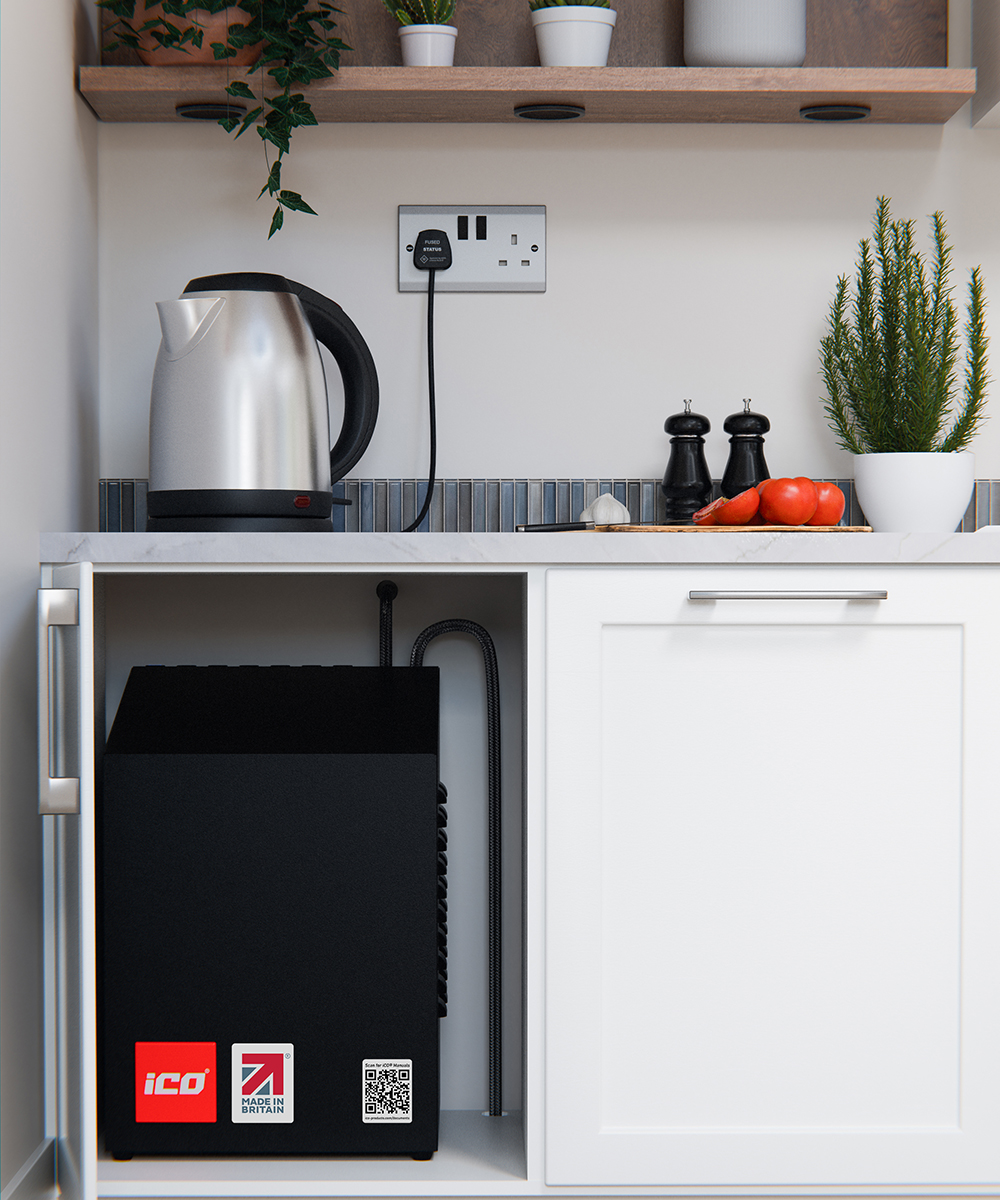
The iCO® High Pressure Water Mist system is tested and verified to BS 8458:2015, the British Standard for domestic and residential water mist systems.
It is designed specifically to protect domestic and residential occupancies, including houses, flats, care homes and student accommodation – the very building types addressed by BS 9991:2024.
Key features include:
This means that where BS 9991:2024 references sprinklers, iCO® Water Mist can be adopted as an equivalent suppression system, provided the design and installation meet the relevant recommendations of BS 8458:2015 and the manufacturer’s DIOM.


